When every administrator offers the same capabilities, the buyer stops choosing on capability.
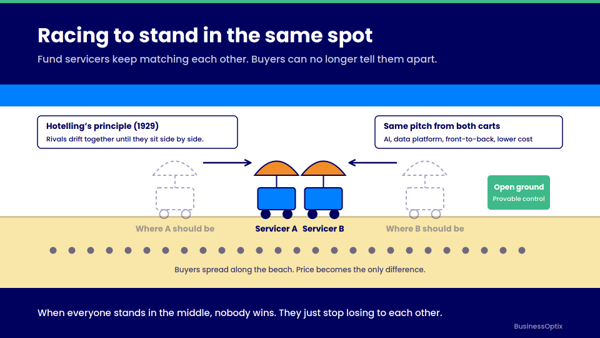
Hotelling's principle: rivals drift together until they sit side by side
There is an old economics problem about two ice cream sellers on a beach. Each one, afraid of losing customers to the other, edges towards the middle. They end up side by side, selling the same thing from the same spot. Harold Hotelling described it nearly a hundred years ago.
For fund administrators, custodians and servicing BPOs, it’s playing out in real time today.
Every pitch says the same thing
Look at the current proposals from the major servicers by emphasised component.
- AI-enabled operations.
- A modern data platform.
- Front-to-back coverage.
- A single global operating model.
- Follow-the-sun delivery.
- Lower cost to serve.
The problem is that it is everyone's pitch. Each firm sees a rival announce a capability and moves to match it, then tries to edge past. The result is a cluster of providers standing in the same place, each one marginally ahead of the others for a few months at a time.
From the buyer's side of the table, they become very hard to tell apart.
Why it happens
RFPs are written from templates by the same consultants asking the same questions. Analysts rank servicers on the same axes. And regulation dictates structure and outcomes.
It turns the market into a commodity.
What commoditisation does to price
When capability stops separating providers, price takes over. Servicing fees in this market are typically a percentage of AUM, transaction-based or fixed, and often built with cascading reductions over the life of the contract.
Asset Servicing fees are going to be 25% lower by 2030
But what about the real cost of the work. The cost drivers in fund servicing are things like the number of legal entities under the funds and the number of controls that have to be run and evidenced. A fee tied to AUM does not move when a client adds twelve entities across three jurisdictions. The servicer absorbs it, and margin quietly erodes while the client believes it is getting a good deal.
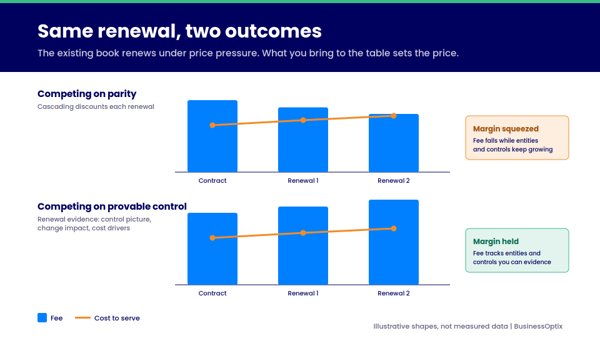
Same renewal, two outcomes: parity pricing versus evidence-based pricing (illustrative)
The buyer is not choosing on features anyway
Most of the revenue in the Asset Servicing market is renewal. Moves between servicers happen, but they are few, slow and risky. So the real question a COO is asking is not who has the best AI roadmap. It is: who can I trust to change things without breaking them, and who can prove what they actually do for me?
Where a servicer could stand instead
The open ground is provable control. That means being able to show a client, an auditor or a regulator:
- Exactly which processes and controls run for that client, across every variant? SITUATION: The same process differs across clients, within a single client and across geographies.
- What changes, step by step, when work moves location or a process is automated? REQUIREMENT: So approvals take weeks rather than quarters.
- Where the real cost sits? PROOF OF VALUE: So pricing can be tied to entities and controls rather than a percentage that bears no relation to effort.
- Does AI in the process produces deterministic, auditable outcomes? MANDATE: Because that is what the industry and its regulators require.
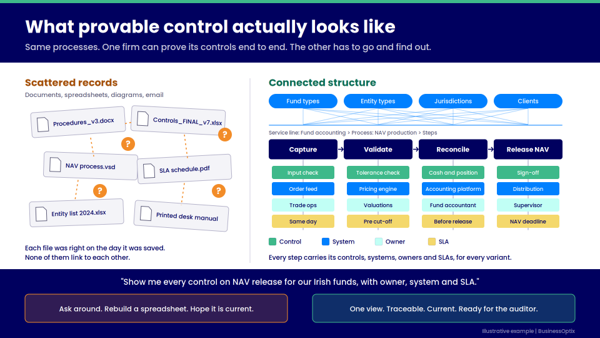
What provable control looks like: scattered records versus a connected structure (illustrative)
Why few will move
For someone in Asset Servicing, standing somewhere different is uncomfortable. It means showing clients your own process variation, which most servicers would rather keep internal. And it requires the operations, sales and pricing teams to agree on a story.
That discomfort is exactly how you can win.
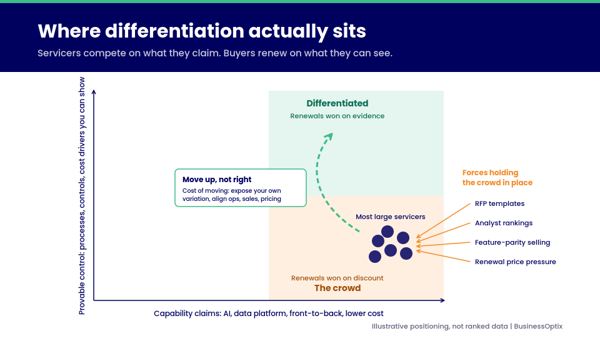
Where differentiation actually sits: move up, not right (illustrative)
What Asset Servicing leadership need to ask
- If we removed our logo, could a client tell our proposal from our three nearest rivals?
- Can we show any client its full process and control picture in a day?
- Does our pricing reflect entities and controls, or are we subsidising complexity?
- How long today does a client approval for offshoring or automation take, and why?
- When we renew this customer, what evidence do we bring beyond the service reports to maintain and grow our price point?
The point
The leapfrog race on capabilities has made the large servicers look the same and pushed the competition onto price. The firms that step out of it and compete on provable control will win renewals on trust rather than discount.
If you run a servicing operation and want to see what a client-level process and control picture looks like, I am happy to show you one.
Book a call with our team to learn more.